Access to External UK HPC Facilities
The United Kingdom has a number of HPC facilities external to the University of Sheffield which will grant researchers HPC resources. These include Isambard-AI (the UK’s first Tier-0 system), national facilities (Tier-1) such as ARCHER2 and regional systems (Tier-2).
The Research and Innovation IT team in IT Services and the Research Software Engineering (RSE) team can help researchers prepare applications for external HPC resources. They can provide technical advice and draw on experience of previous access calls.
Once access has been awarded, these teams can also collaborate with projects to support their use of systems such as Isambard AI. They have previously supported Sheffield researchers using Bede and JADE II.
Further Tier 1 and Tier 2 systems are also listed below with a brief explanation of their purpose along with links for further details.
UK National HPC Systems
Section guidance last updated: 28 October 2026
ARCHER2

ARCHER2 is the UK national supercomputing service for large parallel jobs. Its HPE Cray EX system has an estimated peak performance of 28 PFLOP/s and 5,860 compute nodes. Each node has two 64-core AMD EPYC 7742 processors at 2.25 GHz, giving 750,080 CPU cores across the system. Nodes are connected by the HPE Slingshot interconnect.
The service includes expert user support from EPCC. Academic allocations are available through EPSRC and NERC routes, with pump-priming access for initial testing and benchmarking in the EPSRC remit. Other access routes include paid access. See the operator’s hardware description and access information for full specifications, eligibility and application requirements.
ARCHER2 access is scheduled to end at 17:00 GMT on 20 November 2026. Login, job submission and access to its home, work and solid-state scratch filesystems will end then. Projects with allocations extending beyond the service end have been contacted about continued HPC access. The ARCHER2 end-of-service guide has the timeline and recommended data-transfer actions; the Cirrus migration guide describes transition arrangements for projects moving to Cirrus.
Isambard AI
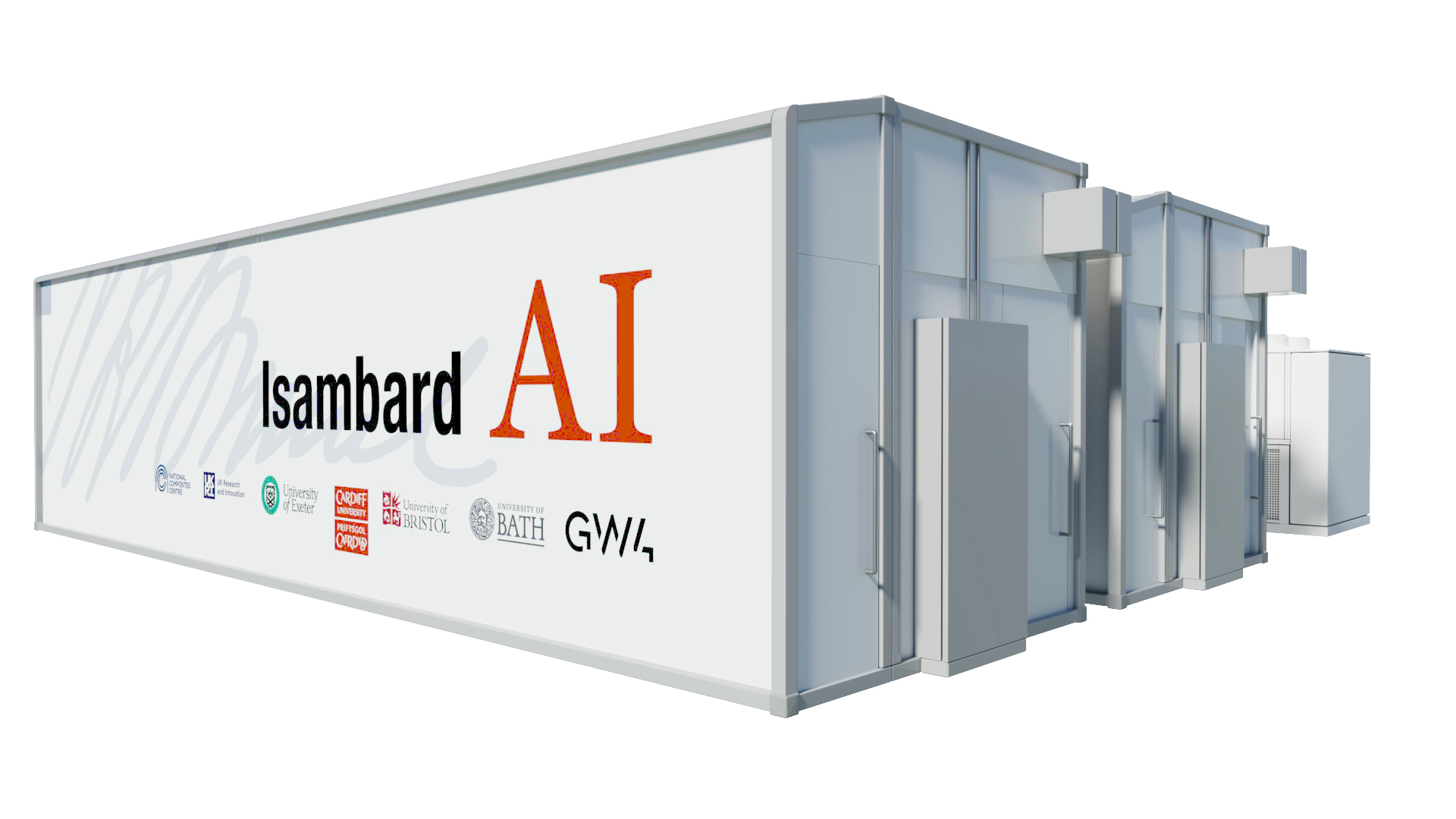
Isambard AI is one of the UK’s AI Research Resource (AIRR) large-scale HPC/AI systems. It is operated by the University of Bristol for UKRI/DSIT.
Isambard AI provides large-scale GPU computing for AI research using NVIDIA Grace Hopper (GH200) superchips:
Phase 1 has 42 compute nodes, containing 168 GH200 superchips.
Phase 2 has 1,320 compute nodes, containing 5,280 GH200 superchips.
Each node has four GH200s: 288 Arm CPU cores, four H100 GPUs with 96 GB memory each, and 460 GB of usable CPU memory.
Nodes use Slingshot 11 networking, with four 200 Gbps network interfaces per node.
Software and containers must support the Arm (aarch64) architecture. See the operator’s system specifications for further hardware details.
Access is allocated through external funding bodies. UKRI routes include Gateway and Rapid Access for initial projects such as porting and benchmarking; these routes have different eligibility requirements. See the operator’s access guidance for current calls and application routes.
Dawn

Dawn is one of the UK’s AI Research Resource (AIRR) large-scale HPC/AI systems. It is operated by the University of Cambridge for UKRI/DSIT.
Dawn provides GPU computing for AI research on 256 Dell PowerEdge XE9640 nodes. Each node contains:
Two Intel Xeon Platinum 8468 processors, giving 96 CPU cores.
1024 GiB of CPU memory.
Four Intel Data Center GPU Max 1550 accelerators, each with 128 GiB of GPU memory, giving 1,024 GPUs across the system.
Xe-Link connections between the four GPUs and quad-rail HDR200 InfiniBand networking between nodes.
See the Dawn hardware documentation for further details.
Cambridge’s AIRR service page describes the current access routes. Gateway supports initial work such as testing and benchmarking for researchers in academia, industry and other UK organisations. Rapid Access supports eligible UK micro, small and medium organisations developing AI products. Applications are made through the AIRR portal linked from that page.
EPSRC affiliated HPC Systems
Section guidance last updated: 27 October 2026
Cirrus at EPCC

Cirrus at EPCC is hosted at the University of Edinburgh and is now a UK National Compute Resource. It supports computational simulation, modelling and data science for academic and industrial research. The current HPE EX4000 system has 640 compute nodes and 184,320 CPU cores:
Each node has two 144-core AMD EPYC 9825 processors, giving 288 cores.
576 standard-memory nodes have 768 GB of DDR5 memory each.
64 high-memory nodes have 1,536 GB of DDR5 memory each.
Nodes are connected by HPE Slingshot 11 networking.
See the Cirrus hardware guide for full specifications. The Cirrus website provides academic and industry access routes, including opportunities to try the service for academic research.
Isambard at GW4

Isambard 3 is the GW4 Tier-2 HPC system, distinct from Isambard AI. Its main Arm-based system has 384 nodes, each containing a NVIDIA Grace CPU Superchip with two 72-core CPUs and 240 GB of CPU memory. Nodes use Slingshot 11 networking at 200 Gbps.
Its Multi-Architecture Comparison System (MACS) also provides x86 CPU nodes and NVIDIA A100, NVIDIA H100 and AMD MI100 GPU nodes. This enables researchers to compare applications across processor architectures.
Access is available through UKRI Tier-2 calls and GW4 institutional allocations; see the operator’s access guidance for eligibility and application routes.
Cambridge Service for Data Driven Discovery (CSD3)

Cambridge Service for Data Driven Discovery (CSD3) supports computationally intensive research, including simulation, data analysis and AI. It combines the Cumulus CPU cluster and Wilkes3 GPU cluster. The CPU resources include Intel Cascade Lake, Ice Lake and Sapphire Rapids processors; Wilkes3 uses NVIDIA A100 GPUs. The clusters use HDR InfiniBand networking. See the CSD3 user documentation for the individual node specifications.
The service supports Cambridge researchers, external academics and industry. Access arrangements depend on the allocation or collaboration; see Cambridge’s national facilities information. The external account application requires an invitation and an agreed primary contact; an account application does not itself award a compute allocation.
Sulis at HPC Midlands+

Sulis at HPC Midlands+ was funded as a Tier-2 platform for ensemble computing and is hosted at the University of Warwick. It combines CPU and GPU resources to run many smaller calculations across different inputs or models. Such high-throughput workflows support applications including materials modelling, chemistry and plasma physics, and enable larger parameter studies and uncertainty estimates.
The operator’s access notice states that UKRI funding and the advertised access routes ended in March 2026. Consult the operator for subsequent availability rather than applying through those expired routes.
MMM Hub (Materials and Molecular Modelling Hub)

The MMM Hub (Materials and Molecular Modelling Hub) provides Tier-2 computing for the materials and molecular modelling community. Its Young cluster supports small and medium-scale calculations on HPE nodes with two 20-core Intel processors per node. The operator lists 23,040 CPU cores and 48 NVIDIA A100 GPUs.
Partner-institution researchers apply through their institutional contact. For researchers elsewhere in the UK, access is available through the Materials Chemistry Consortium (MCC) and UK Car-Parrinello Consortium (UKCP), both of which accept members with suitable research interests. Small exploratory allocations are also available to test workflows before requesting a larger allocation. See the Young service page for contacts and application details.
NI-HPC

The NI-HPC Centre is jointly managed by Queen’s University Belfast and Ulster University. Its Kelvin2 cluster supports research including chemistry, drug discovery, precision medicine, computational neuroscience and hydrogen safety.
Kelvin2 provides dual-socket, 128-core AMD EPYC CPU nodes and high-memory nodes with 2 TB of RAM. Its GPU resources include NVIDIA V100, A100 and H100, AMD MI300X and Intel Max 1100 accelerators, supporting a range of GPU programming environments. EDR InfiniBand connects compute and storage. See the operator’s Kelvin2 description for the hardware inventory.
National allocations are available through UKRI Access to HPC calls, alongside access for the partner universities. Consult NI-HPC for the current application requirements and available resources.
STFC affiliated HPC Systems
Section guidance last updated: 27 October 2026
Dirac

DiRAC provides HPC services for the STFC theory and modelling communities, including astronomy, cosmology, particle physics and nuclear physics. Its resources support different computational requirements:
Data-intensive services at Cambridge and Leicester support modelling and analysis involving large datasets, with CPU and GPU resources at Cambridge and high-memory options at Leicester.
The memory-intensive service at Durham uses the COSMA systems for large cosmological simulations.
The extreme-scaling service at Edinburgh uses the GPU-based Tursa system for workloads including quantum chromodynamics.
See the DiRAC service descriptions for current hardware and suitable workloads.
Compute allocations are awarded through STFC’s Resource Allocation Committee (RAC) calls. Seedcorn allocations are available throughout the year for testing, benchmarking and code development, with discretionary allocations providing another route. See Getting Access for eligibility, application forms and current calls.
Previously Affiliated HPC Systems
Sheffield previously had access to Bede and JADE. These pages are retained as historical references.