Stanage Specifications
Operating System and software
Section guidance last updated: 27 October 2026
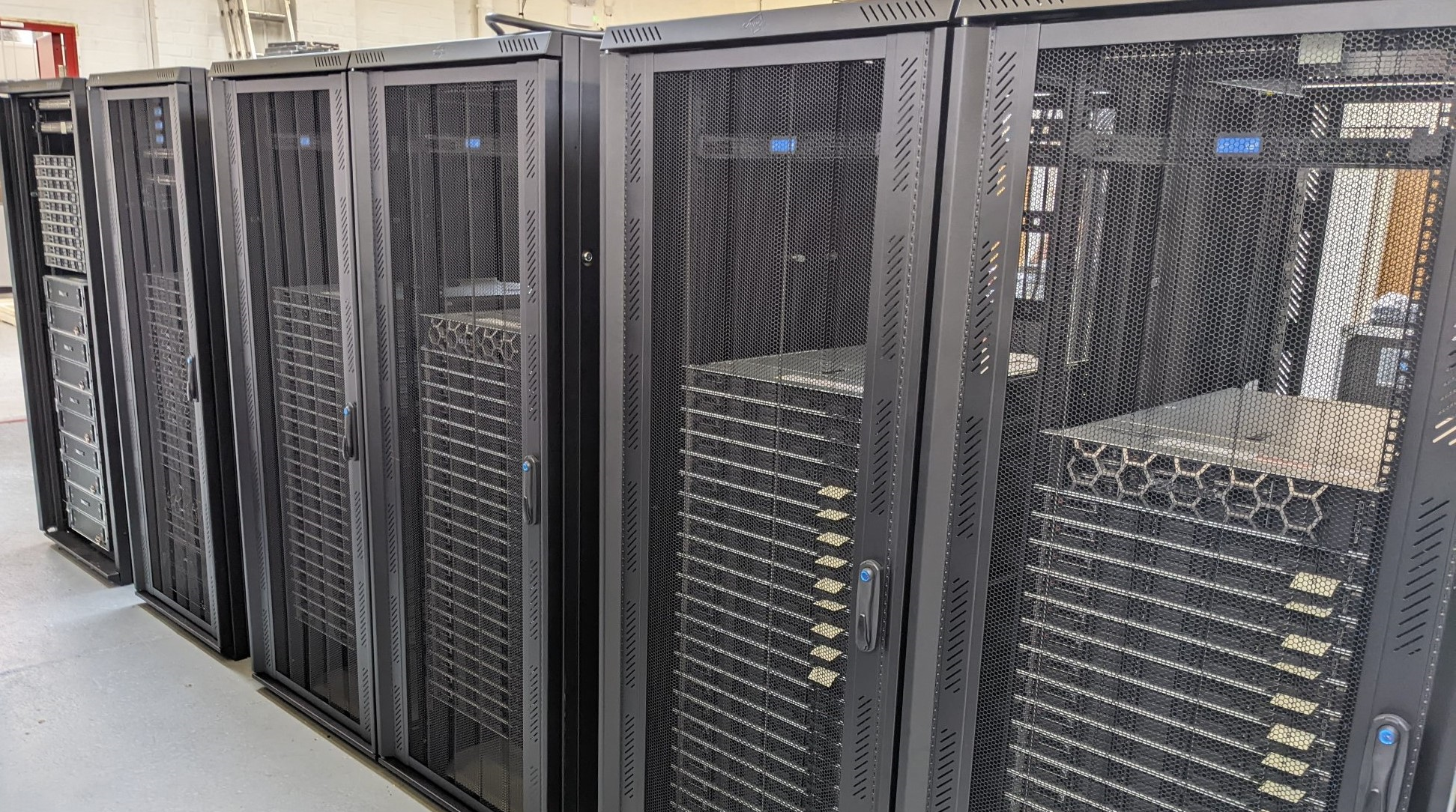
OS: AlmaLinux 9 (Enterprise Linux 9).
Interactive and batch job scheduling software: Slurm.
Many applications, compilers, libraries and parallel processing tools. See Software on Stanage.
Networking
Intel OmniPath Architecture (OPA) (100 Gb/s) to all public nodes.
25 Gigabit Ethernet.
General CPU node specifications
Available RAM figures below are the memory configured in Slurm for jobs, rounded down to whole GB per node and whole MB per core. For RAM, GB and MB use Slurm’s 1024-based convention (1 GB = 1024 MB). Installed RAM is higher than available because some memory is reserved for the operating system.
142 nodes are currently publicly available.
Machine: Dell PowerEdge R650.
CPUs: 2 x 32 core Intel Xeon Platinum 8358:
Ice Lake processor microarchitecture;
Base clock 2.60 GHz; Boost clock 3.40 GHz;
Support for AVX-512 vectorisation instructions (simultaneously apply the same operation to multiple values in hardware);
Support for Fused Multiply-Add instructions (expedites operations involving the accumulation of products e.g. matrix multiplication);
Hyperthreading is disabled on all nodes.
RAM: 256 GB (250 GB available, i.e., 4004 MB / core):
3200 MT/s;
DDR4.
Local storage:
Job-specific node-local scratch: use
$TMPDIRwithin your Slurm job. Copy results to another filestore before the job ends and the directory is deleted. See Scratch directories for details.
Large memory node specifications
To complement the standard nodes with 250 GB of available memory per node (4004 MB/core), there are 12 large memory nodes with 1 TB (16108 MB available / core), and a further 12 very large nodes with 2 TB (32217 MB available / core).
Large memory nodes
12 nodes are currently publicly available.
Machine: Dell PowerEdge R650.
CPUs: 2 x 32 core Intel Xeon Platinum 8358:
Ice Lake processor microarchitecture;
Base clock 2.60 GHz; Boost clock 3.40 GHz;
Support for AVX-512 vectorisation instructions (simultaneously apply the same operation to multiple values in hardware);
Support for Fused Multiply-Add instructions (expedites operations involving the accumulation of products e.g. matrix multiplication);
Hyperthreading is disabled on all nodes.
RAM: 1024 GB (1006 GB available, i.e., 16108 MB / core):
3200 MT/s;
DDR4.
Local storage:
Job-specific node-local scratch: use
$TMPDIRwithin your Slurm job. Copy results to another filestore before the job ends and the directory is deleted. See Scratch directories for details.
Very large memory nodes
12 nodes are currently publicly available.
Machine: Dell PowerEdge R650.
CPUs: 2 x 32 core Intel Xeon Platinum 8358:
Ice Lake processor microarchitecture;
Base clock 2.60 GHz; Boost clock 3.40 GHz;
Support for AVX-512 vectorisation instructions (simultaneously apply the same operation to multiple values in hardware);
Support for Fused Multiply-Add instructions (expedites operations involving the accumulation of products e.g. matrix multiplication);
Hyperthreading is disabled on all nodes.
RAM: 2048 GB (2013 GB available, i.e., 32217 MB / core):
3200 MT/s;
DDR4.
Local storage:
Job-specific node-local scratch: use
$TMPDIRwithin your Slurm job. Copy results to another filestore before the job ends and the directory is deleted. See Scratch directories for details.
GPU nodes
A100 GPU node specifications
13 nodes are currently publicly available.
Machine: Dell PowerEdge XE8545.
CPUs: 2 x 24 core AMD EPYC 7413:
Zen 3 processor microarchitecture;
Base clock 2.65 GHz; Boost clock 3.60 GHz;
Hyperthreading is disabled on all nodes.
RAM: 512 GB (501 GB available, i.e., 10708 MB / core):
3200 MHz;
DDR4.
Local storage: 460 GB boot device (SSD) plus 2.88 TB scratch temporary storage (RAID 0 on SSDs).
GPUs: 4x NVIDIA A100, each with:
High-bandwidth, low-latency NVLink GPU interconnects (3-4x the bandwidth of PCIe for inter-GPU comms)
80GB memory (HBM2e).
H100 GPU node specifications
6 nodes are currently publicly available.
Machine: Dell PowerEdge R7525.
CPUs: 2 x 24 core AMD EPYC 7413:
Zen 3 processor microarchitecture;
Base clock 2.65 GHz; Boost clock 3.60 GHz;
Hyperthreading is disabled on all nodes.
RAM: 512 GB (501 GB available, i.e., 10708 MB / core):
3200 MHz;
DDR4.
Local storage: 460 GB boot device (SSD) plus 960 GB scratch temporary storage (SSD).
GPUs: 2x NVIDIA H100, each with:
PCIe connectivity (NB 3-4x less bandwidth than NVLink for inter-GPU comms)
80GB memory (HBM2e).
H100-NVL GPU node specifications
4 nodes are currently publicly available.
Machine: Dell PowerEdge R760xa.
CPUs: 2 x 48 core Intel Xeon Platinum 8468:
Sapphire Rapids processor microarchitecture;
Base clock 2.10 GHz; Boost clock 3.80 GHz;
Hyperthreading is disabled on all nodes.
RAM: 512 GB (501 GB available, i.e., 5354 MB / core):
5600 MHz;
DDR5.
Local storage: 3.84 TB NVMe SSD with 1.92 TB scratch temporary storage (SSD).
GPUs: 4x NVIDIA H100 NVL, each with:
PCIe connectivity (NB 3-4x less bandwidth than NVLink for inter-GPU comms)
94GB memory (HBM3).
Note
While both the H100-NVL and H100 GPU nodes contain “H100” GPUs, the H100 NVL variant in the H100-NVL nodes is substantially different from the H100 GPUs in the H100 nodes. The H100 NVL is a newer GPU featuring 15% more CUDA and tensor cores alongside 95% more memory bandwidth than the older H100 GPU. In some work loads the H100 NVL may be up to 50% faster in practice.
Non-worker nodes
Two login nodes (for resilience).
Other nodes to provide:
Lustre parallel filesystem.
Slurm scheduler ‘head’ nodes.
Total capacity
With all workers including GPU and large memory nodes:
Worker nodes: 205.
CPU cores: 12896.
Intel Cores: 11744.
AMD Cores: 1152.
Available memory per node: see the CPU and GPU node specifications above.
GPUs: 104.
Fast network filesystem (Lustre): 2.2 PB.